
01
Workflow DesignProcess Reimagination
Rethink existing workflows, responsibilities and handoffs. Identify where AI agents can take action, coordinate activities and enable teams to work differently.
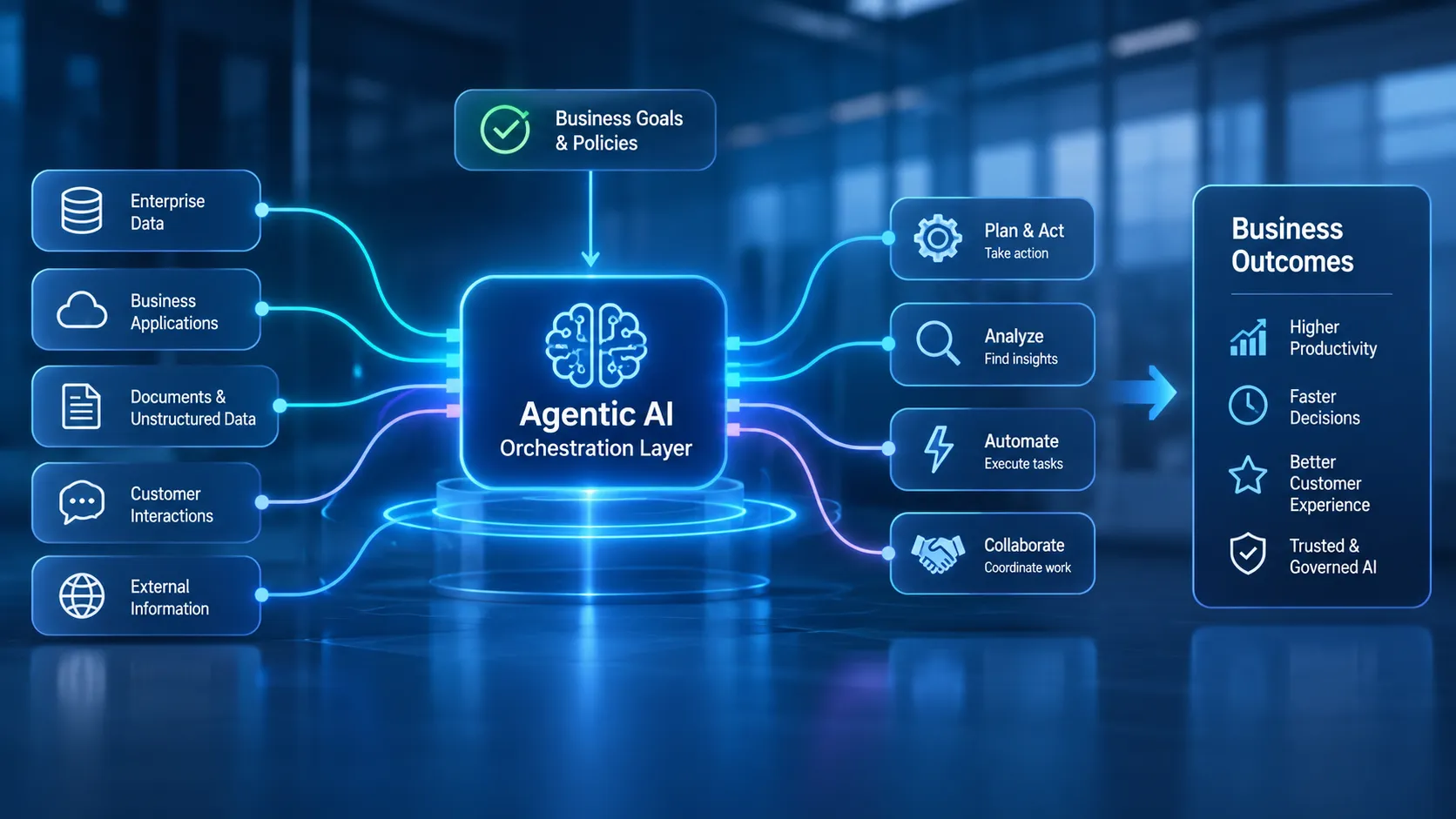
AI has already changed how individuals work. Teams can research faster, generate content, write code and process information with unprecedented speed.
Yet these gains often remain confined to individual tasks. Why?
Because introducing AI into an existing process does not necessarily improve the process itself.
Adding a chatbot to an inefficient workflow, automating one isolated step or connecting an AI model to an existing application may produce incremental improvements. It rarely transforms how the organization operates.
The bigger opportunity is to question the process, not just the technology.
Individuals use AI to write, summarize, research or code faster, while underlying handoffs, bottlenecks and approval queues remain unchanged.
Work flows differently across teams and systems. Governed AI agents take on defined responsibilities, coordinate activities across applications and support faster, better decisions.
Every organization has its own processes, constraints, systems and ways of working.
Our approach starts by understanding these realities rather than arriving with a predetermined AI solution.
Understand existing processes, responsibilities and dependencies.
Identify bottlenecks, repetitive work and decision-making challenges.
Explore where AI agents can meaningfully change the way work gets done.
Identify opportunities for human-agent collaboration.
Define business objectives, expected outcomes and measurable success criteria.
Assess feasibility, investment requirements and implementation priorities.
The objective is not to introduce AI everywhere. It is to identify where it makes a meaningful difference.
Once the opportunity is clear, we work through the business and technical considerations required to make it real. Our work spans both ends of the spectrum: from organizational process changes and team workflows to the engineering details of deploying reliable, secure and governed AI agents.
Rethink existing workflows, responsibilities and handoffs. Identify where AI agents can take action, coordinate activities and enable teams to work differently.
Establish clear objectives, prioritize opportunities and define the metrics that will determine whether an AI initiative is successful.
Design and develop agents, tools, integrations and orchestration workflows that operate within the organization's existing applications and technology ecosystem.
Select appropriate models and supporting technologies based on the use case, performance, cost, reliability, deployment requirements and enterprise constraints.
Align solutions with enterprise security, privacy, access control, data handling and AI governance requirements. Build appropriate human oversight and controls into agentic workflows.
Deploy, monitor and measure real-world performance. Refine workflows, prompts, models and agent behaviour based on actual usage and outcomes.
No AI system or business process is perfect from day one.
The effectiveness of an agentic AI solution depends not just on its initial accuracy, but on how it is monitored, evaluated and improved over time.
We believe enterprise AI needs a continuous improvement approach.
Establishing measurable performance baselines before deployment.
Monitoring actual agent behaviour and workflow outcomes.
Evaluating accuracy, reliability and exceptions.
Keeping humans involved where judgment, accountability or approval is required.
Learning from real-world usage and continuously refining the solution.
Measuring improvements against the original business objectives.
Start with a conversation about your business processes, the challenges your teams face and the outcomes you want to achieve.
We would be happy to explore the opportunities, evaluate the possibilities and help you understand what a practical path towards Agentic AI could look like.